
SEO, AEO and GEO: What Do B2B Companies Really Need?

Nejc Dobrila, co-founder of Website Gorillas
Last updated: 3 min read
Definitions in one sentence
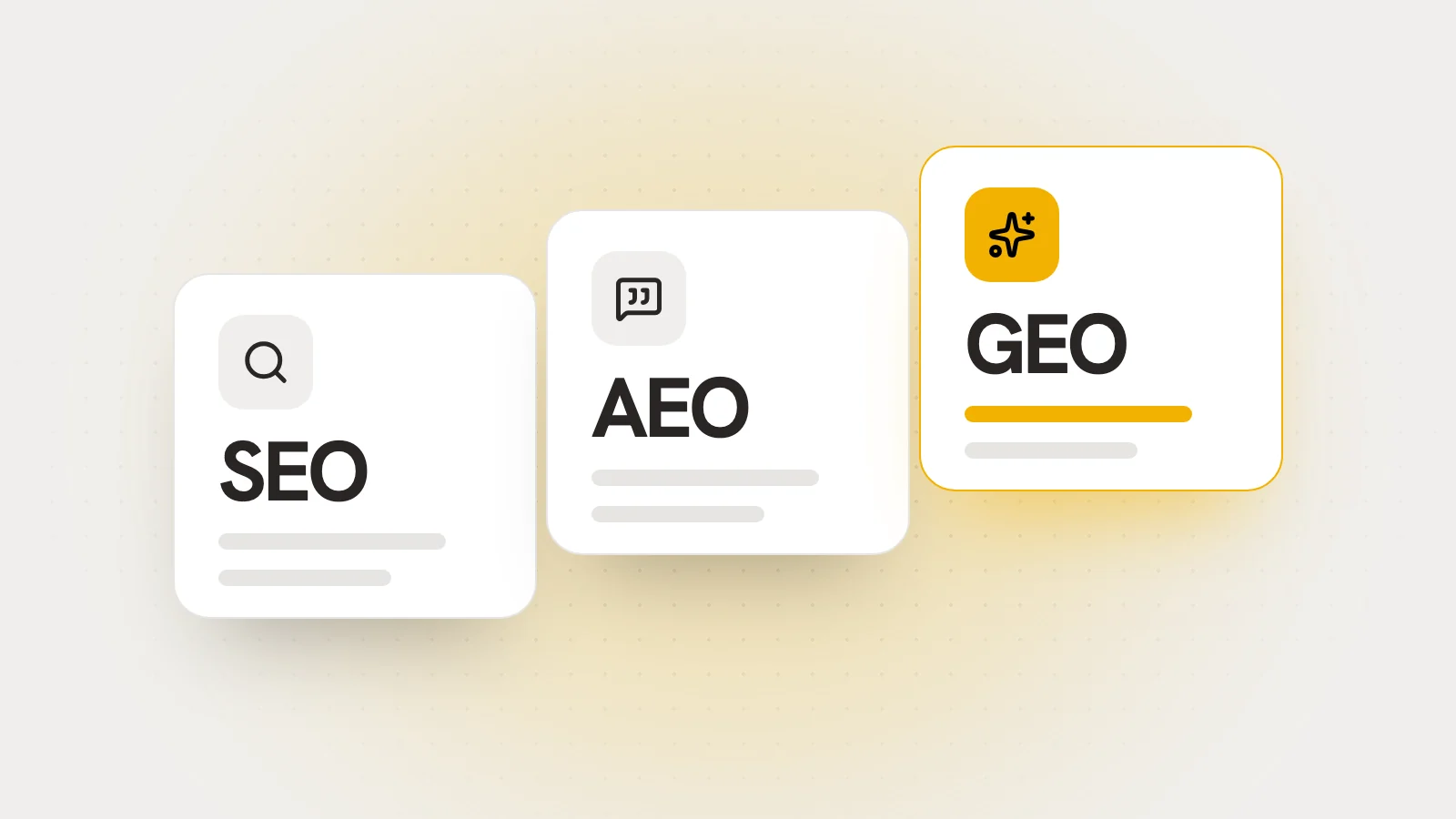
- SEO (Search Engine Optimization) is optimizing your website to rank higher in traditional Google and Bing results.
- AEO (Answer Engine Optimization) is optimizing content so AI search engines recognise it as the most relevant answer to a user's question.
- GEO (Generative Engine Optimization) is optimizing so that generative AI search engines mention you as a source or recommend you as a provider.
Comparison
| SEO | AEO | GEO | |
|---|---|---|---|
| Where they find you | Google, Bing | Google AI Overviews, answer boxes | ChatGPT, Gemini, Perplexity, Claude |
| Success metric | Rankings, clicks, traffic | Your content in the answer | Brand mentions and recommendations |
| What counts | Keywords, technical SEO, links | A clear answer up front, questions as subheadings | Authority, consistent facts, third-party sources |
How the difference plays out in practice
Take a buyer looking for a new supplier.
- With SEO they find you if they click your result on Google. Without the click, they learn nothing.
- With AEO AI uses your explanation when asked "how do I choose a supplier". The buyer reads your expertise even without clicking.
- With GEO AI says your name when asked "who do you recommend". That is the moment you make the shortlist.
In short: SEO makes you findable, AEO makes you useful, GEO makes you recommended.
Why SEO alone is no longer enough
When an AI Overview appears, the click-through rate of the first Google result is about 58% lower (Ahrefs, 2026, 300,000 keywords). At the same time, 94% of business buyers say they use AI at some point in their buying process (Forrester, Buyers' Journey Survey 2025). Some buyers get their answer before they ever reach your site.
That doesn't mean SEO is dead. Google is still a major traffic source, and some AI sources overlap with its results. It does mean SEO without AEO and GEO covers only part of the buyer's journey.
What all three have in common
- A fast, technically sound site. If a search engine or AI can't read the site, nothing else helps.
- Content with real value. Answers to the questions buyers actually ask.
- A focus on buyer intent. We don't write for an algorithm, but for the person making the decision.
That is why we don't do one instead of another, but all three together.
What your company needs
| Your situation | Where to start |
|---|---|
| An old or slow website | Technical foundations and a new page structure first |
| Good Google rankings, AI doesn't mention you | AEO and GEO: clear answers, consistent facts, external sources |
| Little traffic and few mentions | SEO and AEO together, with a content cluster on your core topic |
| Selling abroad | GEO in the languages of your target markets |
Frequently asked questions
Are AEO and GEO the same thing?
The terms overlap and many people use them interchangeably. AEO focuses on answers, GEO on mentions and recommendations in generative search engines.
Does GEO replace SEO?
No. GEO builds on SEO. Without solid technical foundations and quality content, GEO doesn't work either.
Where should I start?
By checking where you stand. The process is in How to check if ChatGPT mentions your company.
Not sure where to start?
Send an inquiry and we'll look at where you lose buyers: on Google, in AI answers, or both.
Sources
- Ahrefs, AI Overviews reduce clicks (2026, 300,000 keywords)
- Forrester, State of Business Buying 2026 (Buyers' Journey Survey 2025, nearly 18,000 business buyers, published January 2026)